
Duolingo claims that its English course content is aligned with CEFR level B2, with a Duolingo score capped at 129 at the end of the advanced course. This alignment between the content offered and the level actually achieved deserves a skill-by-skill examination, because covering B2 material in an app does not guarantee that learners have mastered that level when assessed independently.
Duolingo score and Duolingo English Test: two metrics not to confuse
The Duolingo score built into the course tracks progress through the app’s sections, units, and lessons. It reflects progress through the curriculum, not a language certification. The Duolingo English Test, by contrast, is a separate certified exam, independent of the free course.
Confusing the two is like comparing an odometer with a driving test. A learner can have a high course score without ever taking the certified test, and vice versa. This distinction is missing from most general-interest articles on the subject, even though it is essential to any serious discussion of Duolingo levels up to B2 and their real-world value.
The CEFR itself defines six levels (A1 to C2), with precise descriptors for each skill: reading comprehension, listening comprehension, written expression, spoken production, and spoken interaction. An app score, whatever it may be, does not cover these five dimensions equally.
Reading comprehension and grammar: where the app excels

Duolingo’s English exercises focus heavily on reading and grammar practice. Translation, fill-in-the-blank sentences, and vocabulary matching: the format encourages learners to recognize structures and acquire vocabulary in context. In these areas, a dedicated learner can indeed approach B2 as described by the CEFR—that is, understand complex texts on both concrete and abstract topics.
The advanced course covers a range of topics (current affairs, work, culture) that goes well beyond the tourist vocabulary of the early levels. Grammar units include subordinate clauses, the conditional, and reported speech, all of which are expected at B2.
Listening comprehension also benefits from dictation and listening exercises. The synthetic voices have improved, and the app offers different accents. Even so, listening to isolated sentences lasting a few seconds is a far cry from following a lecture, podcast, or conversation between native speakers at a natural pace.
Spontaneous speaking: the gap between guided exercises and independent assessment
Speaking remains Duolingo’s main structural weakness for learners aiming for B2. The company acknowledges this and has introduced conversation and video features to address the gap. However, we still see a persistent difference between repeating a model sentence and sustaining an improvised argument with another speaker.
The CEFR’s B2 descriptor for spoken interaction states that speakers should be able to:
- Take part in conversation with enough spontaneity for interaction with a native speaker to feel natural
- Develop a point of view on a current topic, explaining the advantages and disadvantages of different options
- Express themselves clearly and in detail on a wide range of subjects related to their interests
Duolingo’s pronunciation exercises assess phonetic reproduction, not the ability to construct a speech in real time. A learner who completed the entire advanced course without ever practicing with a human conversation partner would probably fall short of B2 in this skill on an independent speaking test (such as Cambridge B2 First or the IELTS speaking section).
Usage data and completion rates: what Duolingo does not publish
Duolingo’s 2025 annual report mentions an internal study of learners who completed five sections of the course. No public data specifies what proportion of users completes these sections or how many actually reach B2. The activity metrics it reports (daily active users, consecutive-day streaks, accumulated XP) measure engagement, not language proficiency.
This lack of transparency makes it difficult to make categorical claims about the course’s effectiveness. B2-calibrated content produces a B2 learner only if they complete the program and address their gaps in free-form speaking and writing through other means.
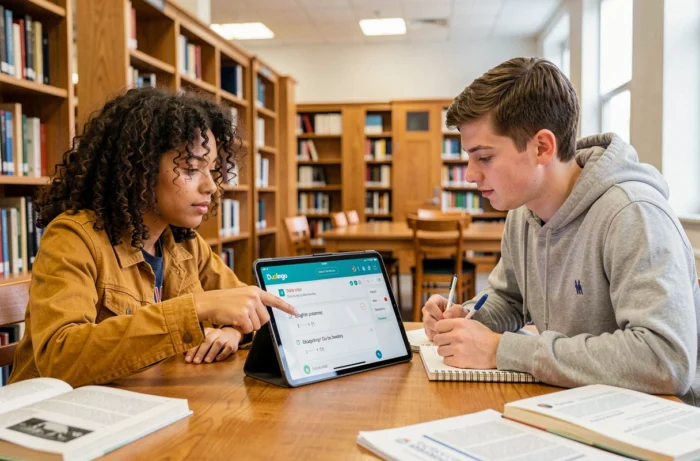
A realistic strategy for reaching B2 in English with Duolingo as a foundation
Duolingo works as a structured foundation for grammar, vocabulary, and comprehension, not as a complete, self-sufficient B2 program. To address its blind spots, a realistic learning plan combines several resources:
- Use Duolingo daily to make systematic progress in grammar and contextualized vocabulary, up to the maximum score in the advanced course
- Supplement it with authentic English content (podcasts, TV series, news articles) to practice listening at a natural pace
- Practice speaking with a human conversation partner (language exchange, online tutor) at least once or twice a week
- Take an independent test (Cambridge B2 First Certificate, IELTS, or the Duolingo English Test itself) to assess your actual level across all five CEFR skills
B2 English is within reach for a motivated learner who uses Duolingo as a backbone, provided they add regular speaking practice and external assessment. The app provides structure and consistency, but conversational fluency is built elsewhere. Aiming for a score of 129 in the course without ever speaking English means preparing for only half the exam.