
A travel story published online is never a neutral act. It features inhabited places, real people and sometimes fragile local economies. Understanding what this kind of content involves—from French legal requirements to on-the-ground practices—helps distinguish a sincere account from a merely decorative travel diary. This article compares the obligations, formats and approaches that set a transparent travel story apart from one that is not.
Commercial transparency and travel stories: what French law requires from 2026
A traveler who publishes photos and articles after a stay paid for by a tourism board or a brand is doing more than simply recounting their experience. Since January 1, 2026, a written contract has been mandatory in France when the cash payments and in-kind benefits received from the same advertiser reach €1,000 excluding VAT in a year for the same promotional objective.
This rule changes the landscape for travel blogs, photo journals and podcasts funded through compensation. Advertising intent must be clearly disclosed, even when the content reads like a simple personal account.
| Criterion | Before 2026 | Since January 1, 2026 |
|---|---|---|
| Threshold | No uniform monetary threshold | €1,000 excluding VAT per advertiser and promotional objective per year |
| Written contract | Recommended, but not always mandatory | Mandatory once the threshold is reached |
| Disclosure of commercial intent | Required by platforms, unclear under the law | Required by law; penalties may apply |
| Formats covered | Mainly video and social media | All published content (blogs, podcasts, e-books, photos) |
A travel story that aims to be sincere benefits from disclosing the circumstances in which it was produced, even below the threshold. Transparency is more than a legal obligation: it is essential to earning readers’ trust.

For travelers documenting less widely covered regions, such as rural Transylvania or the Ethiopian highlands, the question becomes even more pressing. A stay funded by a local organization can lead to a useful account, provided readers know the circumstances in which it was written. Resources such as the Transylvania Unpacked guide illustrate this approach by documenting a region without concealing the perspective from which the content is produced.
Photographing and writing about encounters without turning people into scenery
A recent travel journalism guide recommends explaining your project to the people you want to photograph or quote, accepting a refusal, and never treating individuals as an emotional hook or a prop. Local rules vary: some sacred sites prohibit all photography, and photographing children raises specific concerns in many countries.
The issue goes beyond politeness. A story that uses an encounter as proof of authenticity without providing context about the person perpetuates a pattern in which the traveler remains the subject and the local person becomes a prop. A sincere account conveys the context of the encounter, not just the traveler’s emotions.
Several factors distinguish a respectful account from an extractive one:
- Consent is requested before taking the photo and before publishing it, not afterward. The person knows where and how their image will be used.
- The text accompanying the photo describes what happened without embellishing the story or attributing thoughts to the person photographed.
- The account acknowledges what the traveler does not know or understand, rather than filling in the gaps with hasty cultural interpretations.
This kind of narrative discipline takes time. It also produces more nuanced writing because it resists the temptation to explain everything.
Community-based tourism: sharing local experiences without speaking for residents
Experts quoted by DW describe the growth of community-based tourism, with smaller travel groups and increasing interest in experiences rooted in local communities. The strongest projects are designed in partnership with local communities, which decide how their territory is developed.
A sincere travel story makes this dynamic visible instead of erasing it. Too often, published accounts describe a village, market or ceremony as if the traveler had discovered it. A story is more honest when it names the local organizations that arrange visits and clarifies whether an activity was created for visitors or existed before they arrived.
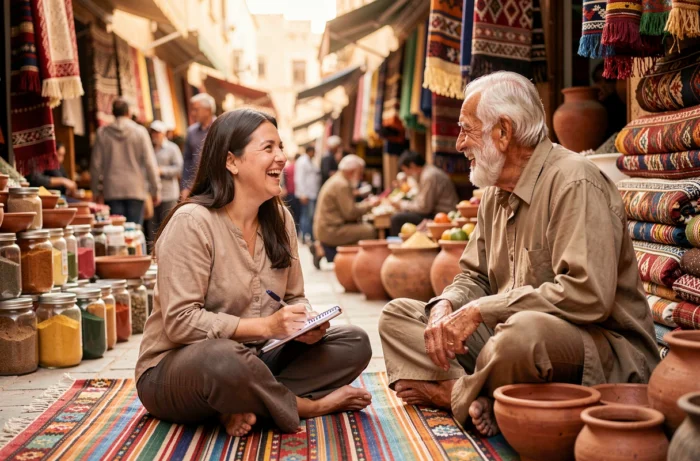
The line between community-based tourism and conventional tourism dressed up as local culture is not always easy to draw on the ground. One reliable indicator is who set the price, itinerary and rules for visits. If the answer is a tour operator based in another country, the word “community-based” deserves quotation marks in the account.
Writing about this kind of experience also means resisting the urge to deliver a moral verdict. Travelers do not have to certify that a project is “good” or “bad” for the community. They can describe what they saw, what they were told and what seemed unclear, then let readers form their own opinions.
Travel story formats compared: blogs, journals, podcasts and books
The format you choose affects what a story can convey. A blog post can be updated, a book fixes the text in place, a podcast captures the sounds of a place, and a journal combines sketches with notes.
| Format | Strength for sincere storytelling | Main limitation |
|---|---|---|
| Blog | Can be corrected, put into context and updated after publication | SEO pressure can encourage writers to smooth over their message |
| Journal (print or digital) | Preserves raw impressions from the field | Offers little perspective and may reproduce immediate biases |
| Podcast | Captures the voices and soundscapes of the place visited | Editing can skew the story, and including local languages can be difficult |
| Book | Time for rewriting allows for nuance and fact-checking | Fixed once printed, with no possibility of correction |
No format guarantees sincerity. An SEO-focused blog can be more honest than a book if the author describes the conditions of their trip, their misjudgments and what they failed to understand. The sincerity of a travel story depends on the author’s approach, not the medium.
Writing a useful travel story: practical quality criteria
A travel story that is useful to readers serves several purposes at once: it informs, provides context and acknowledges its limitations. The following criteria can help determine whether a piece goes beyond an illustrated personal diary:
- The story specifies the dates, season and length of the stay, because a place can change dramatically depending on the time of year.
- Practical information (how to get there, costs, languages spoken) is woven into the text rather than relegated to a generic sidebar copied from a guidebook.
- The author distinguishes what they saw from what they were told, and what they understood from what they missed.
- Photos include captions with the exact location and, where relevant, the person’s name (with their consent).
A travel story becomes more valuable when it makes readers more attentive, not more envious. An account of a market that details prices, smells and interactions between local vendors and shoppers offers more insight than a retouched photo with a lyrical caption.
Long-form writing, whether published on a blog or in a book, remains the best format for bringing description, context and reflection together. The stories that are read for years are rarely those that promise wonder. They are the ones that describe a place as it works, with its contradictions, its own rules and residents who do not pose for the camera.