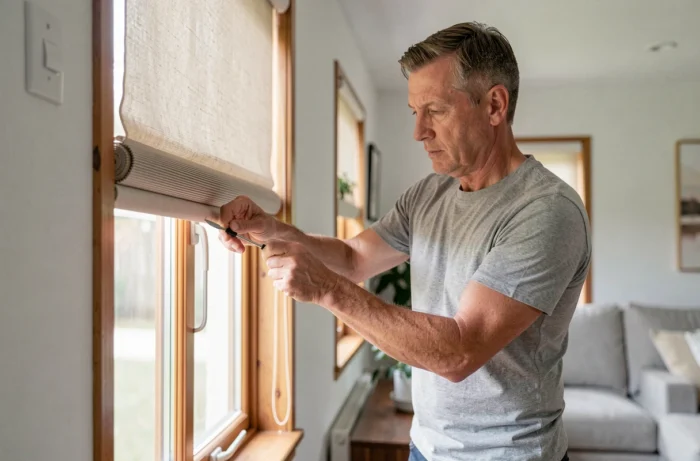
A roller blind that refuses to retract or whose fabric rolls up crookedly almost always points to a localized mechanical problem. Identifying the faulty part before touching any brackets can prevent a simple repair from turning into a complete replacement.
Return spring and axle end cap: the two parts responsible for most jams
In an indoor spring-loaded roller blind, the roller tube houses a pre-tensioned helical spring that provides the tension needed to raise the fabric. When the spring loses tension or breaks, the blind lowers normally but no longer retracts, or rises sluggishly before stopping halfway.
To tell a loose spring from a broken one, remove the blind from its wall brackets and turn the tube by hand. If you can still feel resistance, the spring is working but not tensioned enough. If the tube turns freely with no resistance, the spring is broken and needs replacing.
Another common point of failure is the axle end cap, the plastic part inserted into each end of the tube. A cracked end cap or one with a broken locking tab prevents the tube from staying in place in its bracket. The blind may seem jammed even though the internal mechanism is intact. If you want to repair a roller blind with Retbutiko, the process starts by checking the end caps before doing anything to the spring.
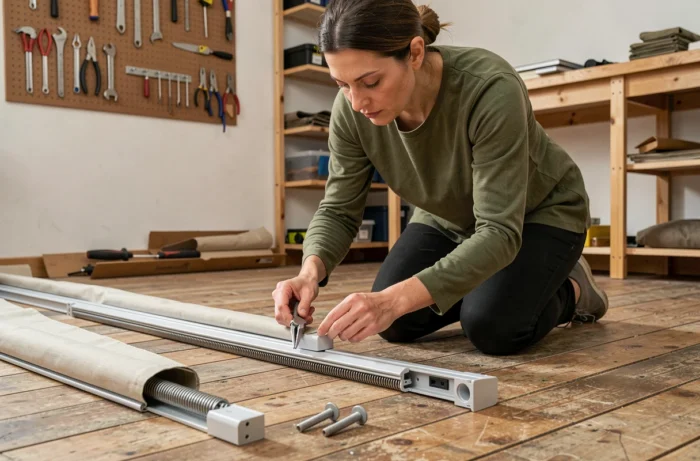
Retensioning an indoor roller blind spring without damaging it
Retensioning the spring is the most common repair and requires no specialized tools. The principle is simple: manually roll the fabric onto the tube to recharge the spring tension, then put the tube back in place.
Retensioning procedure
- Unhook the blind from its brackets. On most models, simply lift the tube and pull it toward you, or press a retaining clip.
- Wind the fabric around the tube by hand, making five to seven full turns in the original winding direction. Hold the tube firmly to keep the spring from unwinding.
- Put the tube back into its brackets, inserting the spring end first (usually the left side), then clipping the opposite end into place.
- Test the retraction by pulling the fabric down and then releasing it. If the tension is still too weak, repeat the process, adding two or three more turns.
Add turns gradually. Over-tensioning the spring can cause it to snap or make the blind retract too abruptly, damaging the fabric or the stopping mechanism.
Chain spins freely: repairing the ball-chain clutch mechanism
On a chain-operated roller blind, the problem is not the spring but the ball-chain clutch mechanism housed in one of the brackets. If the chain turns without moving the fabric, the internal cog that drives the tube is no longer engaging.
Remove the mechanism cover (usually held in place by a simple clip or screw). Inspect the toothed cog and the ring around it. Accumulated dust and textile fibers can form a felt-like buildup that prevents the gears from engaging. In most cases, cleaning with a dry brush followed by a drop of silicone lubricant on the cog teeth is enough.
If the cog teeth are visibly worn or broken, the mechanism needs to be replaced. We recommend ordering the part from the blind manufacturer and specifying the tube diameter (usually 25 mm or 38 mm for indoor models) to ensure you get a compatible clutch.
Check the chain itself too
A stretched chain or one with deformed beads can slip over the cog without turning it. If you have a new section available, compare the spacing between its beads with the old chain. Irregular spacing between the beads confirms that the chain needs replacing, not the mechanism.
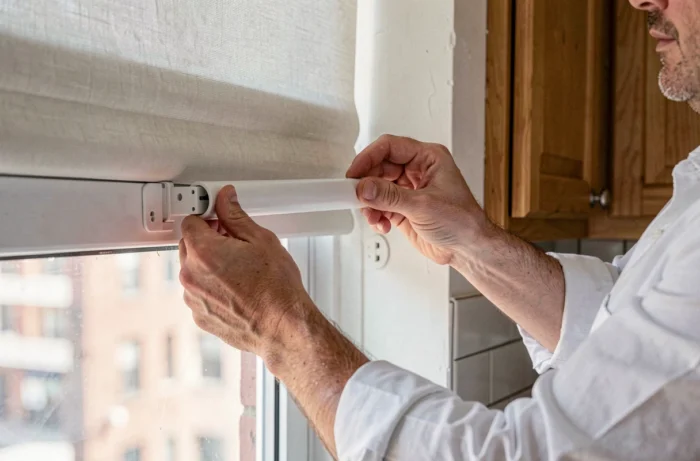
Damaged roller blind fabric: trim it or replace it
A tear a few centimeters from the bottom of the blind can be trimmed if the remaining length is still suitable for the window. Measure the usable height, add three centimeters for folding into the bottom rail, then cut straight with a utility knife along a metal ruler.
If the fabric is torn in the middle, replacement is preferable to a visible patch that will weaken the material around the repair. Most manufacturers sell replacement fabric by the meter, cut to fit the width of the tube.
When reinstalling the new fabric, make sure it is attached straight to the tube. Even a few millimeters of misalignment can cause it to roll up in a spiral, eventually rubbing against the bracket and jamming the blind again.
Safety after repairs: the detail most guides overlook
Cords and chains that form a hanging loop pose a strangulation risk to young children. After every repair or reinstallation, put the wall-mounted tension device back in place (the small hook that keeps the chain taut against the wall). If the device is missing or was never installed, fit one high enough to prevent the loop from hanging freely.
Also check that the wall brackets are still securely anchored. Repeatedly removing and reinstalling the tube puts strain on the wall plugs, especially in drywall. Metal expansion anchors provide a more durable fixing than the original plastic plugs supplied with the blind.
A properly diagnosed roller blind can be repaired in under half an hour with a screwdriver, a brush and, if needed, silicone lubricant. The only situation that warrants calling a professional is an outdoor motorized blind whose tubular motor has stopped responding, since the repair involves electrical connections and recalibrating the limit switches.