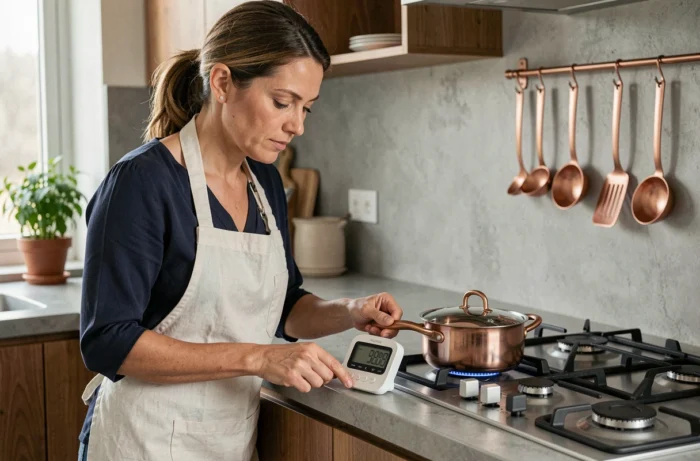
Cooking an ingredient doesn’t end when you turn off the heat. It continues with the storage method you choose, and most guides overlook this connection between cooking time and what happens to the dish afterward. A cooking time calibrated for immediate consumption is not suitable for a dish refrigerated for two days or for food sterilized in a jar.
Cooking time and storage: two inseparable factors
A fish fillet poached for dinner and the same fillet intended for a jar don’t follow the same heat-treatment guidelines. In the first case, cooking is aimed at achieving the right texture and short-term safety. In the second, it must neutralize spore-forming microorganisms, since Clostridium botulinum spores can withstand ordinary heat.
Anses points out that low-acid canned foods require a sterilization process whose duration and temperature must follow the sterilizer manufacturer’s instructions. Simply boiling a jar of ratatouille or duck confit for a long time is not enough to guarantee its safety.
For cooked dishes that have not been sterilized, refrigeration takes over. Successful cooking does not eliminate the risks associated with improper storage: Anses stresses the importance of observing use-by dates and keeping food cold. Adapting cooking times in the kitchen to what will happen to the dish means treating cooking and storage as a pair rather than as separate steps.
Three scenarios call for three distinct approaches:
- Immediate consumption: cooking targets the desired texture and the minimum level of food safety (an appropriate internal temperature for the ingredient).
- Refrigeration for two to three days: cooking slightly beyond the ideal serving point helps compensate for quality loss during reheating and reduces the residual microbial load.
- Canning: sterilization requires standardized temperature and time stages, regardless of the ideal texture of the freshly cooked dish.
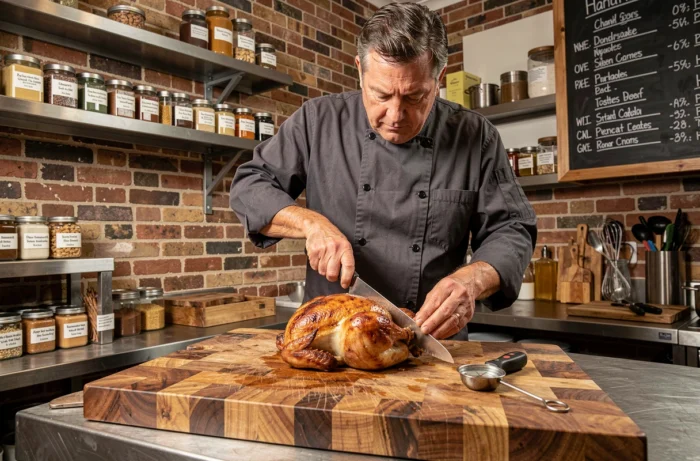
Cooking mushrooms: a safety guideline often overlooked
Foraged mushrooms clearly illustrate the difference between cooking time for texture and cooking time for safety. Anses recommends cooking foraged mushrooms for at least 20 minutes before eating. This threshold is not about tenderness or browning: it is intended to break down potentially toxic heat-sensitive compounds.
A quick three-minute sauté produces a crisp mushroom, but does not meet this food-safety requirement. Conversely, cooking a high-quality porcini mushroom for twenty minutes may seem excessive from a purely culinary perspective. The cooking time therefore depends on the type of mushroom (cultivated or wild) and the level of risk you are willing to accept.
This guideline applies specifically to mushrooms and should not be applied to vegetables or meat. Each food group has its own requirements, which is why a single chart of “universal cooking times” often leads to mistakes.
Meat and fish: internal temperature matters more than cooking time
Timing a piece of meat without measuring its internal temperature is like navigating without a compass. A two-kilogram beef roast and a one-kilogram roast placed in the same oven at the same temperature will not reach the same level of doneness after forty minutes.
A meat thermometer is the only reliable tool for deciding whether meat is rare, medium or well done. Suggested cooking times (a certain number of minutes per pound) are a starting point, not a final verdict. The thickness of the cut, its starting temperature, the oven’s convection and whether it contains a bone all affect how quickly heat penetrates.
Resting after cooking: a cooking stage in its own right
Taking meat off the heat does not stop its temperature from rising. Residual heat can raise the internal temperature by several degrees while the meat rests. A duck breast taken off the heat while still pink can become medium if you slice it immediately: the juices escape, the muscle fibers contract, and the final texture disappoints.
Letting red meat rest under a sheet of aluminum foil for a time proportional to its thickness allows the fibers to relax and the juices to redistribute. Resting is an integral part of the total cooking time and should be factored into your meal planning.
Roasted vegetables: mastering caramelization without charring
Roasting vegetables depends on balancing a high temperature with a controlled cooking time. An oven that is too cool produces soft, bland vegetables; one that is too hot burns the surface sugars before the center is tender.
The size of the pieces directly affects cooking time. One-centimeter cubes cook much faster than thick wedges, and their higher surface-area-to-volume ratio encourages the Maillard reaction. Cutting the pieces to a uniform size ensures even cooking across the entire baking sheet.
Root vegetables versus watery vegetables
Carrots, parsnips and beets are dense and low in water, so they can withstand long cooking times without falling apart. Zucchini, eggplant and tomatoes have a high water content, release moisture quickly and can turn mushy if cooked for just a few minutes too long.
Combining these two groups on the same baking sheet means either adding the watery vegetables partway through cooking or cutting the root vegetables into smaller pieces to make up for the difference in density. Ignoring this difference results in an uneven dish, with some pieces charred while others remain raw in the middle.
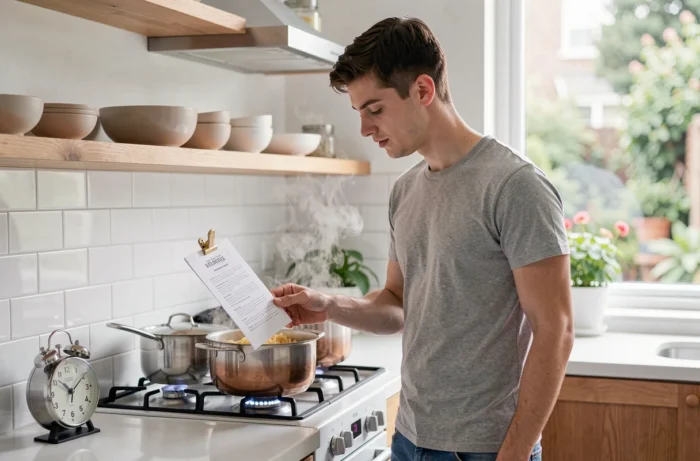
Baking and oven cooking: temperature consistency as the hidden variable
In baking, the margin for error in cooking time is measured in minutes, and sometimes in tens of seconds for delicate preparations such as tuiles or financiers. The time given in a recipe assumes a perfectly calibrated oven, which is rarely the case with home ovens.
A difference of ten to fifteen degrees between the displayed setting and the actual temperature is common. A separate oven thermometer can help correct this discrepancy. Without checking, adjusting the cooking time means trying to compensate for a temperature problem by trial and error.
Opening the oven door during cooking causes the temperature inside to drop sharply. For yeasted doughs and sponge cakes, this loss of heat can cause the structure to collapse before the crust has set. It’s better to watch through the oven door and only check by touch toward the end of the estimated cooking time.
Cooking time never exists in isolation. It depends on the equipment, the ingredients, what will happen to the dish afterward and the level of safety required. Thinking in terms of a system rather than a timer is what takes you from guesswork to confident cooking.