Switching to a natural beauty routine means choosing your products carefully, but also checking what the claims on the packaging actually guarantee. ISO 16128, a standard used to calculate a natural-origin index, does not prohibit microplastics and is not an environmental label.
So a “natural” or “naturally derived” claim on a bottle says nothing, on its own, about the product’s full composition or environmental impact. The goal is not to stock up on products branded as natural, but to understand the difference between a marketing promise and a choice you can verify.
Natural-origin claims, certification and regulations: what each guarantee covers
Three levels of assurance coexist in the cosmetics market, and confusing them leads to most of the misleading comparisons between conventional products and those described as natural.
| Type of guarantee | What it covers | What it does not cover |
|---|---|---|
| “Natural” claim (self-declared) | Natural-origin index calculated according to ISO 16128 | Absence of microplastics, environmental criteria, independent audit |
| Certified label (Cosmébio, Natrue, Ecocert) | Specifications checked by a third-party organization, list of prohibited ingredients, natural-origin thresholds | Reusable packaging, carbon footprint of transport |
| EU microplastics regulations | Ban on exfoliating microbeads since October 2023, extended to rinse-off products in October 2027 and leave-on products in October 2029 | Overall product composition, origin of plant-based active ingredients |
This table shows that a product can display a high natural-origin index while still containing synthetic polymers. Conversely, a product certified by an independent label meets stricter requirements, but that does not guarantee that its packaging is minimal or refillable.
Reading the label with these distinctions in mind makes it easier to buy less and choose better. Retailers such as Naturilys offer ranges whose formulas list all ingredients, making it easier to check them before buying.

Essential oils in your beauty routine: often-overlooked precautions
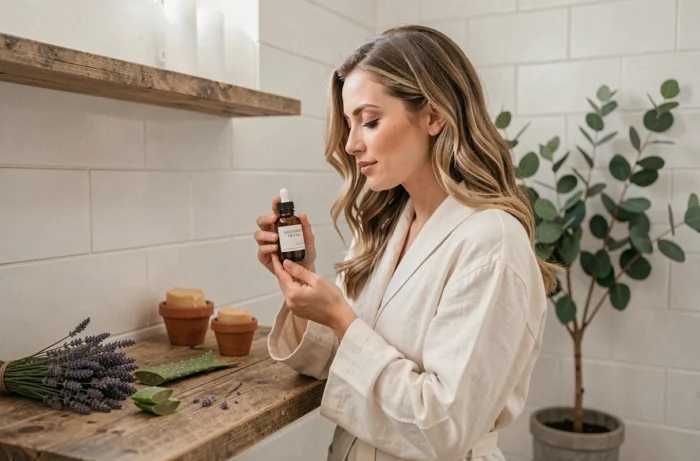
Essential oils are often the first thing people reach for when they want to “go natural.” Yet their high concentration of volatile active compounds makes them more delicate to use than a conventional cream.
Some citrus oils are photosensitizing: applied before sun exposure, they can cause pigmentation or burns. This applies to bergamot, lemon and grapefruit oils, whose furocoumarins react to UV rays.
In addition to photosensitivity, essential oils can irritate or sensitize the skin, especially reactive skin, and should be used with care by pregnant women and young children. Natural does not automatically mean safer for your skin.
What to check before using an essential oil in skincare
- The oil’s chemotype (biochemical variety), shown on the bottle, which determines both its properties and its contraindications
- Dilution in a carrier oil (jojoba, sesame or sweet almond): applying an essential oil neat to the skin increases the risk of irritation
- Avoiding sun exposure for several hours after application of any citrus oil or oil containing furocoumarins
Adding more essential oils to your routine does not make it more effective. For most everyday needs, one or two carefully chosen bottles suited to your skin type and used with the proper precautions are enough.
A natural, low-waste routine: fewer products, less packaging
A responsible beauty routine is not measured by how many natural products line your bathroom shelves. Reducing the number of products helps cut both costs and packaging waste.
Reusing containers is a separate consideration from choosing ingredients. A refillable glass bottle containing a conventional skincare product can generate less waste than five single-use plastic bottles filled with organic cosmetics. Confusing a natural formula with efforts to reduce packaging makes it harder to make progress on both fronts.
Three ways to create a gentle, low-waste beauty routine
First, identify products that serve more than one purpose. Jojoba oil can be used as a makeup remover, a moisturizing facial serum and a treatment for hair ends. One bottle replaces three products.
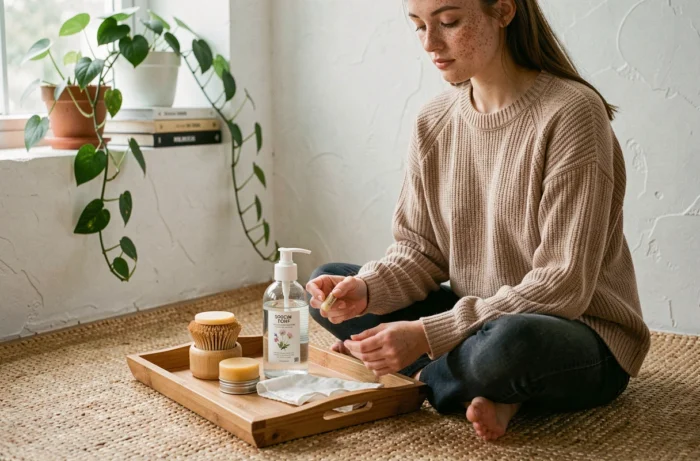
Second, consider the format: choosing refillable containers or solid products (soap, solid shampoo, solid toothpaste) reduces plastic use. A well-formulated solid shampoo replaces two to three bottles of liquid shampoo in terms of uses.
Third, rethink your shopping habits. Finish one product before opening another to avoid waste and give yourself time to properly assess how well it works for your skin before replacing it.
Natural ingredients for different areas: face, body and hair
Not every natural ingredient is suitable for every part of the body. Facial skin is thinner and more exposed, so it needs different active ingredients from the scalp or body skin.
For the face, aloe vera provides lightweight hydration without a greasy film, making it suitable for combination skin. Sesame oil helps protect the skin barrier and is suitable for dry to normal skin. Green tea, rich in polyphenols, can be used as a floral water or as an extract in antioxidant skincare products.
For the body, shea butter remains a classic choice for dry areas such as elbows, heels and hands. Apply it on its own or mix it with a few drops of plant oil to help it absorb.
For hair, coconut oil works as a pre-shampoo mask on damaged lengths. It penetrates the hair fiber better than most plant oils, but can weigh down fine hair if too much is applied to the roots.
Matching each ingredient to the area you want to treat helps avoid disappointment and waste from unsuitable products. A product that works on the body may clog facial pores, and vice versa.
Building an effective natural beauty routine depends more on making precise choices than on the number of products you use. Checking what the label actually guarantees, following precautions for essential oils and limiting your routine to products suited to your skin remain the most reliable ways to combine gentleness, effectiveness and responsibility.