What kind of yield can you expect from a vegetable garden when water is in short supply for several weeks each year? The promise of homegrown vegetables all year round rests on an assumption that is rarely questioned: a constant supply of water for irrigation. Since September 1, 2024, the decree and order of July 12, 2024 have governed the domestic use of water unfit for human consumption, including rainwater collected for the vegetable garden.
Local drought restrictions can prohibit watering vegetable gardens at certain times, or even ban it altogether, as the example of Maine-et-Loire reported by Cholet Agglomération has shown. A productive vegetable garden must therefore also be planned around the water that is actually available.
Vegetable gardens and water restrictions: how regulations affect what you grow
Most gardening guides treat watering as a technical variable (frequency, flow rate, mulching). The regulatory framework calls for a different perspective: water is not always available, even when it has been stored.
| Situation | Use of stored rainwater | Use of mains water |
|---|---|---|
| No restrictions | Permitted without a declaration (tank not connected to the home) | Permitted |
| Drought alert (levels 1–2) | Often permitted, with hours varying according to the local prefectural order | Time restrictions may apply |
| Drought emergency (levels 3–4) | May be prohibited depending on the municipality and water supply | Prohibited for vegetable gardens in some departments |
A rainwater tank does not guarantee the right to water during a drought. The prefectural order takes precedence and varies according to the municipality, water supply and intended use. Vegetable gardens are not automatically exempt from bans.
This distinction applies to outdoor use (watering the garden) versus an installation connected to the home’s indoor water system, which requires a declaration to the town hall. No declaration is required for a rainwater collector that is not connected to the home, but the water remains unfit for human consumption.
Before planning the size of your vegetable garden, visit the vegetable garden section of Maison, Jardin … & Services to learn more about layouts suited to these constraints.
Drought-resistant vegetables: crops that produce with little water
Planning a productive vegetable garden in a water-stressed climate starts with choosing crops that need less watering. Vegetable species do not all respond in the same way to several days of dry soil.
Crops to prioritize in areas at risk of water restrictions
- Once well established, tomatoes can tolerate less frequent watering if they have a thick layer of mulch. Their deep root systems partly make up for a lack of water near the surface.
- Squash and zucchini develop broad leaves that shade the soil and limit evaporation. They produce well with weekly watering in mulched soil.
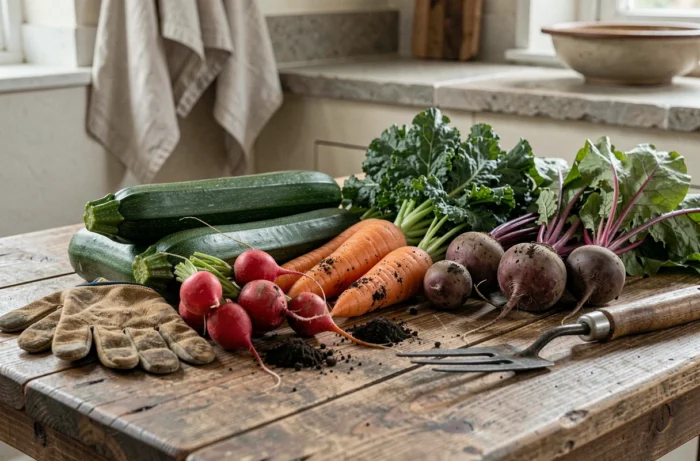
- Root vegetables (carrots, beets, parsnips) draw water from deeper in the soil. Sown in early spring, they reach maturity before the summer drought peaks.
- Dry beans and chickpeas, unlike green beans, are harvested after drying on the plant and need very little water at the end of their growing cycle.
Leafy vegetables (lettuce, spinach) are the most vulnerable to interruptions in watering. Just a few days without water can cause them to bolt, making the crop unusable.
Adjusting sowing dates to water availability
Rather than aiming for continuous production throughout the year, a realistic planting schedule concentrates water-hungry crops in periods when irrigation is permitted and water is available. Spring sowings (March–May) and autumn sowings (September–October) make use of natural rainfall.
A productive vegetable garden does not need daily watering if sowing dates follow local rainfall patterns. In summer, established, mulched crops are more resilient than late sowings that need water to germinate.
Soil and mulch: reducing the vegetable garden’s reliance on watering
Soil is the vegetable garden’s first water reservoir. Its ability to retain water depends directly on its organic matter content.
Soil enriched with compost holds more water than bare, compacted soil. It is not about how much water you apply, but how well the soil can store it, whether it comes from rain or a hose.
Thick mulch: the most water-efficient technique
A layer of mulch several centimeters thick significantly reduces soil evaporation. Straw, hay, wood chips, dried grass clippings: the material matters less than the thickness. A layer that is too thin (less than five centimeters) dries out itself and loses its protective effect.
Mulch also affects soil temperature. In summer, it keeps the root zone cool. In autumn, it extends the growing season by protecting vegetables still in the ground (leeks, carrots, lamb’s lettuce) from frost.
Compost and soil structure in the vegetable garden
Adding compost every year improves soil structure. Clay soil becomes less compact, while sandy soil retains water better. Both lead to the same result: less watering is needed for the same yield.
Spread compost over the surface in autumn or early spring. There is no need to dig it in deeply: soil life (earthworms and microorganisms) will incorporate it.
Rainwater harvesting for the vegetable garden: legal framework and practical limits
Installing a rainwater collector may seem like the obvious solution. The reality is more nuanced.
Outdoor use for watering a vegetable garden is permitted without a declaration to the town hall, provided the tank is not connected to the home’s water supply. Collected rainwater remains unfit for human consumption, but that does not prevent its use in the garden.
The main limitation is storage capacity. A tank holding a few hundred liters can be emptied after just a few summer waterings. For a medium-sized vegetable garden, the supply rarely lasts more than one or two weeks without rain.
- During dry periods, check the current prefectural order before watering, even with stored water.
- Choose a tank size based on the actual area of the vegetable garden and the average length of dry spells in your region.
- Combine rainwater harvesting with water-saving techniques (mulching, crop selection, an adapted planting schedule) rather than relying on storage alone.
A productive vegetable garden all year round is still an achievable goal, provided you do not overlook water availability. Choose suitable crops, apply generous mulch, enrich the soil with organic matter and check local watering rules before each dry season: a vegetable garden’s productivity is measured as much by the liters of water saved as by the kilograms of vegetables harvested.