A lavender bed planted last autumn, a scorching summer, and no watering allowed for three weeks: this is what many French gardens have experienced in recent years. Creating an outdoor space that stays beautiful when water is scarce calls for practical choices from the design stage onward.
Watering restrictions in France are set locally according to different drought levels, and a prefectural order can regulate or ban certain uses overnight. Planning for these constraints is the foundation of a garden that thrives over time.
Gardens and watering restrictions: prepare before drought sets in
Many people assume that having a well or a rainwater collection tank exempts them from restrictions. In practice, wells are not necessarily exempt from prefectural measures. Check the rules on VigiEau and in the order currently in force for your municipality.
The mayor can also use their police powers to impose stricter measures than those set by the prefect. This can mean two overlapping levels of restrictions: one for the département and another for the municipality. Checking both before planning to water or choosing water-hungry plants helps avoid unpleasant surprises in the middle of summer.
In practical terms, it helps to divide your garden into priority zones. Newly planted vegetation (less than two years old) may sometimes qualify for watering exemptions, while established lawns are usually the first to be targeted by bans.
Identifying these zones when planting makes it easier to decide where to focus your efforts when water becomes scarce. Practical guides and planting calendars tailored to these constraints are available at https://www.bon-jardinier.fr, helping you choose between species according to their water needs.
Selective mowing: adjust cutting height to how you use the garden
Mowing the entire garden to the same height every week takes time and fuel, and weakens the soil during dry spells. Selective mowing is based on a simple principle: mow areas used for walking and relaxing, and let the rest grow.
In practice, this means three levels of maintenance:
- Paths and the area around the patio are kept short (around five centimetres) for comfort and a neat appearance.
- Intermediate areas (flower-bed edges and the part of the garden visible from the house) are mowed every two to three weeks, at a greater height.
- Peripheral or rarely used areas are cut only two or three times a season, allowing grasses to grow tall and wildflowers to take hold.
This approach is about more than ecology. It significantly reduces maintenance time and preserves soil moisture wherever the grass is left longer. During a watering ban, grass kept at ten centimetres withstands dry conditions far better than a closely mown lawn.
Water-wise plants: choose species that can cope without summer watering
The usual instinct is to plant in spring. For a drought-resistant garden, autumn is more effective. Roots establish during the cool, wet months, so plants enter the following summer with a deeper root system already in place.
Plants that can tolerate a summer without watering once well established include lavender, rosemary, shrubby salvias, yarrow and many ornamental grasses. These plants have one thing in common: their foliage is often grey, fine or downy, which helps limit evaporation.
Combine layers to cover the soil
Bare soil heats up quickly and loses moisture. Ground-cover plants reduce evaporation more effectively than mulch alone. Creeping thyme, sedums and fleabanes form dense mats that protect the soil while limiting weed growth.
Above this low-growing layer, shrubs such as rockroses, mastic trees and viburnum tinus cast shade. This layering of vegetation recreates what we see in Mediterranean scrubland, where plants protect one another from the sun.
Living soil and biodiversity: create a mosaic of habitats
Applying the same maintenance approach everywhere—mowing everything, mulching everything, weeding everything—depletes the garden. Some wild bees nest directly in the soil: keeping a small patch of bare earth complements flowers and shelters. One square metre of compacted soil exposed to the south, at the edge of a flower bed, is enough to provide a nesting site.
This mosaic approach also applies to mulching. Mulch flower beds and the vegetable garden generously, but deliberately leave a few bare patches. Keep a pile of dead wood in a corner and allow a patch of nettles to grow behind the shed.
Tailor maintenance to each micro-zone
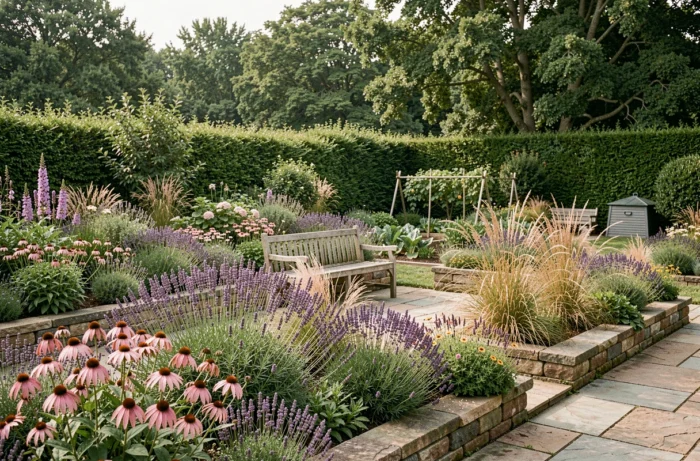
The garden that looks best cared for is not the one where everything is uniform. It is the one where each area is managed in a way that suits its purpose. The patio is immaculate, the orchard has long grass, and the far end of the garden remains semi-wild. This variation adds visual depth and reduces the overall workload.
Conditions vary depending on exposure and soil type: a clay slope facing north behaves very differently from free-draining sand in full sun. Mowing heights, plant choices and watering schedules should therefore be adjusted to each part of the garden, rather than following a one-size-fits-all formula.
A thriving garden does not depend on intensive maintenance everywhere. It depends on planting choices made in advance, dividing the garden according to how each area is used, and knowing when to let nature do a better job than we can. Checking local water restrictions before each season is the most practical way to avoid losing plants and adapt your garden to the summers ahead.