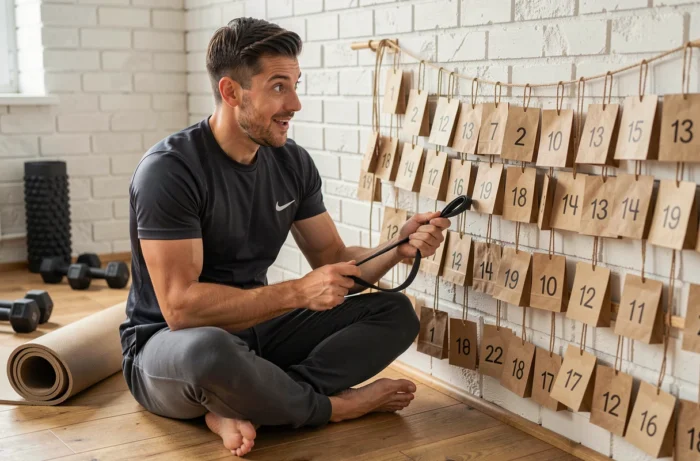
A men’s fitness Advent calendar promises 24 days of discoveries focused on fitness and well-being. The question worth asking is whether this format helps establish a lasting workout routine or mainly serves as an assortment of products you would not otherwise have chosen or used. To find out, you need to compare what these boxes actually contain and assess their usefulness beyond December.
Sports nutrition, accessories or challenges: what fitness calendars contain
The range of sports Advent calendars on the market is heavily weighted toward nutrition. Protein bars, powders, and samples of creatine or BCAAs fill most of the compartments in the most common boxes. Calendars focused on workout equipment remain rare in France.
This distribution creates an imbalance. A man who trains regularly already has his preferred nutrition brands. Receiving 24 single-serve sachets in different flavors changes neither his eating habits nor his progress. By contrast, a box combining recovery accessories (massage ball, resistance band, roller), small strength-training equipment, and relaxation rituals offers a broader range.
Vegan options are available and demonstrate a real diversification of contents within a single box, beyond simply alternating protein flavors or aromas. A men’s fitness Advent calendar is more worthwhile when it combines nutritional discoveries with training tools that can be used over the long term.
| Content category | Frequency in boxes | Usefulness after December |
|---|---|---|
| Nutrition (bars, powders, supplements) | Very common | Low (products are consumed and then forgotten) |
| Fitness accessories (bands, grip tools, balls) | Uncommon | High (daily reuse) |
| Workout challenges (cards, programs) | Rare (mostly DIY) | High (habits established) |
| Well-being / recovery (oil, roller, balm) | Moderate | Moderate (depending on the products) |

Dietary supplements in a sports calendar: what the regulations say
Including dietary supplements in an Advent calendar is not a trivial matter. In France, claims made about these products are regulated: unauthorized health claims are prohibited on packaging and product listings. A calendar that promises “guaranteed muscle gains” or “faster recovery” through its supplement sachets falls outside the law.
For buyers, a useful habit is to check that each supplement lists its ingredients and dosages on the individual packaging, not just on the outer box. A reputable calendar does not hide its ingredients behind the suspense of opening each compartment.
The European General Product Safety Regulation (GPSR), applicable since December 13, 2024, strengthens requirements for fitness accessories sold online. Product listings must make it possible to identify the manufacturer and product, and to consult relevant warnings. An Advent calendar containing a resistance band or weightlifting grip must meet these requirements, even if it is presented as a “gift box.”
A 24-day wellness routine: lasting impact or just entertainment?
A recurring marketing claim is that opening one compartment a day creates a ritual. The mechanism is real: daily consistency over three and a half weeks can help kick-start a habit. But the contents of each compartment determine whether that habit survives into January.
A calendar filled exclusively with consumable products (bars, drinks, gels) leaves nothing behind once all 24 compartments are empty. The habit it creates is opening a compartment, not working out. By contrast, a calendar offering progressive challenges (increasing numbers of push-ups, plank times, circuits to complete) or small pieces of equipment that build into a set creates something tangible.
Here are the criteria that distinguish a calendar capable of establishing a routine:
- Each compartment contains something you can use that day, not a product to store for later
- There is visible progress from compartment 1 to compartment 24, whether in exercise difficulty or in building a complete kit
- At least half the contents remain usable after December 25 (accessory, printed program, recovery tool)
A box that meets all three conditions works like a structured starter pack. The rest make pleasant gifts but have no measurable effect on physical fitness.
Packaging and reuse: an often-overlooked factor
The eco-design of a sports calendar is about more than a “recycled cardboard” label. The option to refill the box the following year is the real mark of sustainability. A calendar made of unfinished wood or fabric with sewn pockets can be filled again with new challenges or accessories. A calendar made of thermoformed cardboard with plastic inserts ends up in the trash on December 26, whatever label it carries.
Comparing calendars based on their actual packaging, the weight of discarded material relative to useful contents, and whether they can be refilled quickly rules out boxes that rely on green marketing without substance.

Choosing a fitness Advent calendar: the trade-offs that matter
The price of a sports calendar varies considerably depending on whether it contains nutrition samples or workout equipment. Nutrition boxes are generally at the lower end of the price range, while those that include accessories (mini dumbbells, push-up bars, graduated resistance bands) cost more.
The best-value trade-off is to assess the cost per reusable item. A moderately priced calendar containing 18 powder sachets and 6 low-quality accessories offers less lasting value than a more expensive box with 12 durable accessories and 12 exercise cards.
- Check the full list of contents before buying, not just the three featured products
- Choose boxes with a reusable or refillable structure
- Check that included accessories meet identification requirements (manufacturer, warnings) under the GPSR
- Avoid boxes where most compartments contain supplement samples without a visible ingredient list
A well-designed sports Advent calendar works like a discovery program condensed into 24 days. A poorly designed one leaves you with a drawer full of half-used sachets and resistance bands you never use again. The decisive factor is the proportion of contents that remain useful beyond December, not the number of compartments or the box’s appearance.