Starting a business is already a challenge. For women, additional obstacles can make the journey even harder: more difficult access to funding, less accessible professional networks, and persistent stereotypes. In this context, having a dedicated media platform can make all the difference. SLR.fr magazine takes this approach, offering an editorial showcase designed for women entrepreneurs in France.
Why a magazine dedicated to women’s entrepreneurship can make all the difference
Have you noticed that profiles of entrepreneurs in the general business press rarely feature women founders? The underrepresentation of women entrepreneurs in the media is no minor issue. It makes it harder for women starting businesses to find partners, investors, and customers.
A specialist media outlet addresses one specific need: bringing stories that remain in the shadows into the spotlight. When a woman business leader is featured in a well-structured, indexed, and widely shared article, she gains credibility within her business community. Her project becomes more tangible to a banker or investment fund.
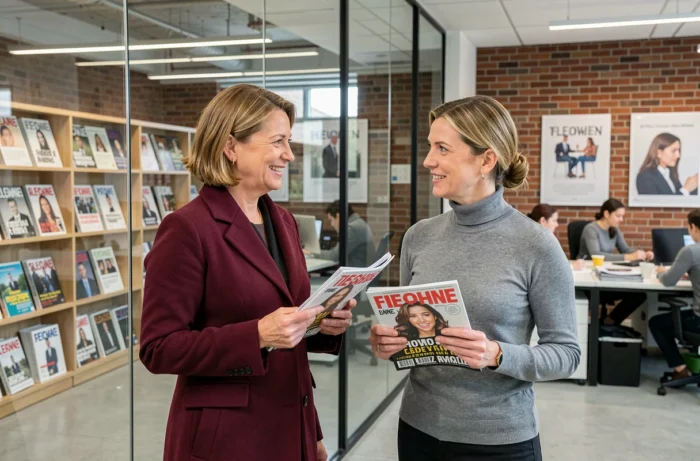
That is exactly the role played by SLR.fr magazine from J’entreprends Au Féminin, combining industry insights with profiles of real women entrepreneurs. The approach goes beyond telling inspiring stories: it provides an editorial platform that positions each woman entrepreneur as a full-fledged economic player.
Funding businesses founded by women: the difference between bank loans and venture capital
The word “funding” covers very different realities. Treating bank loans and venture capital fundraising as the same thing obscures the real challenges.
Bank loans: a process riddled with bias
Overall, women receive less bank financing than men for comparable projects. Application assessment criteria may appear neutral, but interviews with loan officers reveal implicit biases. A woman founder in the tech sector is more likely to be asked about risk management, while a male founder will be asked about growth potential.
Initiatives such as the Égalité Femmes guarantee, backed by France Active, aim to address this imbalance by covering part of the bank’s risk. This practical support mechanism deserves greater recognition.
Venture capital: an even wider gap
The gap is even greater when it comes to fundraising. All-women founding teams receive only a marginal share of the amounts invested. Mixed-gender teams fall somewhere in between, with results that differ from those of all-male and all-female teams.
This distinction between all-women, mixed-gender, and all-male teams is rarely made in public debate. Looking at the composition of the founding team sheds more light on inequality than simply making broad statements about gender.
Editorial support and women’s entrepreneurship: what a magazine can offer in practice
A magazine like SLR.fr is no substitute for an incubator or an investment fund. Its role comes before and alongside the entrepreneurial journey. Why is this positioning useful?
- Targeted strategic insights: articles bring together industry information (regulations, market trends, support schemes) that women entrepreneurs may not have time to research on their own
- Indirect networking: being featured in an article can create opportunities to connect with other business leaders, partners, or journalists
- Online credibility: well-indexed editorial content strengthens a company’s online presence, sometimes more effectively than an advertising campaign
- Practical guidance: short-form content explains technical topics (legal structures, taxation, social protection) in accessible language
This last point deserves a closer look. Social protection for women entrepreneurs remains a blind spot. A self-employed woman just starting out pays low contributions and has limited coverage if she needs to take sick leave or maternity leave. Editorial content that explains these systems offers value far beyond simply providing information.

Student entrepreneurship and business creation: a talent pool to engage early
The desire to start a business is emerging at an increasingly young age, but it masks a gender disparity: even before starting a business, female students express different concerns from their male peers.
The barriers are not purely financial. They also involve confidence, perceived legitimacy, and access to initial professional networks. Supporting future women entrepreneurs from their time on campus helps prevent the gap between intention and action.
A magazine focused on women’s entrepreneurship can play a role at this stage by offering content tailored to students: stories from young women founders, analysis of support available to those without professional experience, or introductions to university incubators open to projects led by women.
Media visibility and the growth of women-led businesses
Visibility is neither a luxury nor just a communications exercise. For a business in its growth phase, being featured in a specialist media outlet can produce measurable results.
An in-depth article targeting search queries related to women’s entrepreneurship attracts a qualified readership. This audience includes influencers, B2B buyers, investors, and institutional partners. Editorial visibility works as an indirect driver of business.
Support networks for women entrepreneurs are multiplying across France. They organize events, awards, and mentoring programs. Media coverage of these initiatives amplifies their reach and attracts new participants. A magazine that documents these developments helps them grow.
SLR.fr’s editorial model is part of this process: producing useful, well-indexed, shareable content that serves both readers and the women entrepreneurs it features. The line between information and a business development tool blurs when content is designed to meet the practical needs of starting and growing a business in France.