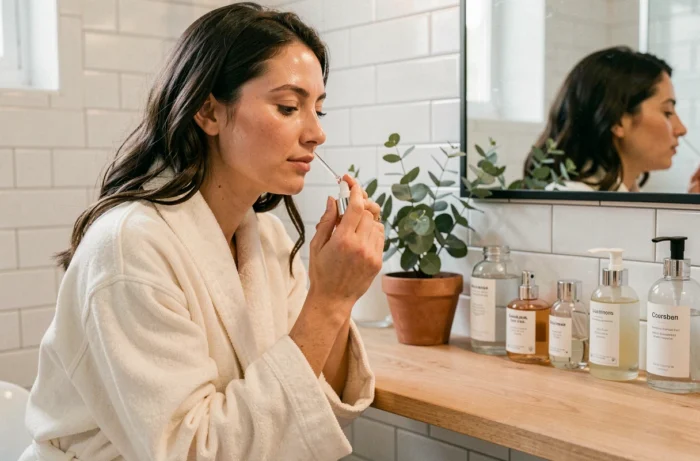
What truly sets this season’s beauty and wellness routines apart from previous ones? From the rise of targeted hair care and the shift of facial actives to body care, to the growing popularity of try-before-you-buy formats, today’s trends point to a market where precision matters more than product accumulation.
Scalp care, retinol body routines and trial sizes: what’s really gaining ground
Three trends stand out in the data available this season. The table below summarizes them before we take a closer look.
| Trend | Observed signal | Key region |
|---|---|---|
| Scalp care | Growing faster than conventional shampoos and styling products | France leads (scalp health is a priority) |
| Face-inspired body care routines | Growing interest in retinol body lotions and skin barrier care | Western markets (Pinterest data) |
| Try before committing to a full routine | Most Ipsy members surveyed want to try sample sizes | Mainly the United States |
These three trends have one thing in common: they reflect a shift from volume to precision. Consumers are using fewer products but expect each one to address a specific area or need.
To keep up with how these trends evolve week by week, Belle et Bien’s latest news regularly rounds up developments in the cosmetics and wellness sectors.

Scalp care in France: why this season marks a turning point
Hair care is no longer just shampoo followed by conditioner. Data from K. Consulting, published in October 2026, shows that scalp care is growing faster than conventional shampoos in the markets studied. France stands out: scalp health is identified as the top priority, while hair growth and preventing thinning dominate in the UK and the United States.
This regional difference directly affects the types of products gaining traction on French shelves. Soothing serums, scalp exfoliants and pre-shampoo treatment masks address skin comfort concerns (itching, excess oil and sensitivity) rather than focusing on hair growth.
What this means for an autumn routine
Adding a scalp treatment doesn’t mean introducing an unnecessary extra step. The idea is to replace an existing step with a more targeted one. Here’s what to check before choosing a product of this kind:
- The formula targets the scalp (not just the lengths) and contains soothing or balancing ingredients such as zinc, panthenol or salicylic acid
- The format allows direct application to the scalp (dropper tip, targeted spray or nozzle applicator) without weighing down the lengths
- The product is either rinse-off or leave-in, depending on how practical you want your existing routine to be
Using a scalp exfoliant once a week may be enough to ease discomfort caused by seasonal changes. By contrast, piling on hair products offers no proportional benefit.
Body care: when facial actives make their way into body routines
Pinterest’s first beauty report describes a trend that is changing the very way we think about body care: body routines are adopting ingredients once reserved for the face. Retinol lotions, body treatments targeting the skin barrier and décolleté serums—the body is no longer treated as an afterthought.
This trend is partly driven by skinimalism in facial care. As face routines become simpler, the attention and budget freed up are shifting to other areas.
Body care ingredients to watch this season
According to Pinterest data, retinol for the body remains the most sought-after active. But other ingredients are following the same trajectory:
- Ceramides in body lotions to restore the skin barrier weakened by autumn cold
- Niacinamide in body lotion to even out skin tone on the arms and legs after summer
- Low concentrations of lactic and glycolic acids for a smoothing effect without irritation across larger areas of skin
One pitfall to avoid: using a facial-strength concentration on the body. Body skin may tolerate some actives less well at high concentrations because the treated areas are larger and overall absorption is greater. Checking the concentration is a good habit before making any purchase.

Trial sizes and product discovery: sample first, full routine later
Ipsy’s 2026 Beauty Discovery Report, covered by Personal Care Insights in October 2026, highlights a consumer behavior that is influencing how brands plan their launches. Most members surveyed prefer to try a sample size before committing to a routine.
This isn’t simply about price. A smaller format makes it possible to check whether an active ingredient suits your skin over two to three weeks—the minimum time needed to see a real effect on complexion or skin texture. Buying a full-size bottle of body retinol serum without trying it first means taking a chance on untested skin tolerance.
How to make the most of this try-before-you-buy approach
Some retailers now offer discovery sets featuring several travel sizes from the same range. This makes it possible to try a cleanser, serum and moisturizer from one line before investing in standard sizes.
This season’s beauty and wellness market isn’t defined by a miracle ingredient or a dominant makeup color. The underlying shift is structural: more targeted care for specific areas (scalp and body), ingredients borrowed from facial routines, and a shopping approach that puts testing before commitment.
The next logical step is for brands to offer scalp and body diagnostics as precise as those already available for the face.