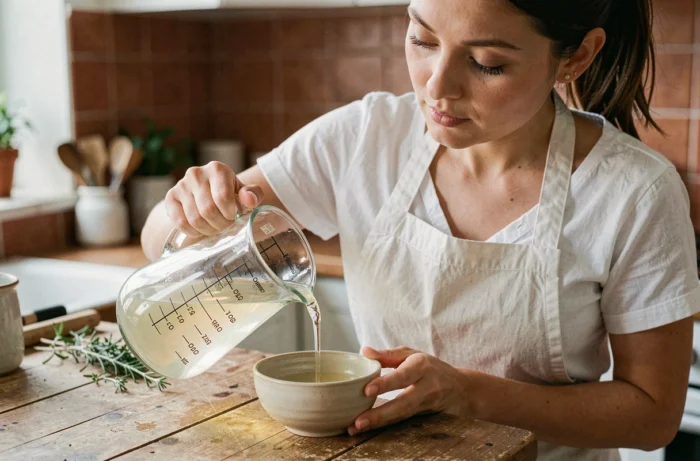
You’re following a recipe, the book says “1/4 litre of milk,” and your measuring jug is marked in centilitres. This mismatch between fractions of a litre and cl graduations often causes hesitation—and sometimes measuring mistakes. The answer is a quick calculation: 1/4 litre is equivalent to 25 centilitres. Behind this conversion is a simple principle that lets you convert any fraction without a calculator.
Why converting litres to centilitres always works the same way
A litre is divided into 100 centilitres. The prefix “centi” means one hundredth, just as a centimetre is one hundredth of a metre. Starting from this basic fact makes every conversion straightforward.
To convert a quarter of a litre to centilitres, divide 100 by 4. The result is 25 cl. The same principle applies to other fractions: half a litre is 50 cl, a third is about 33 cl, and three quarters is 75 cl.
One point that’s often overlooked: strictly speaking, the litre is not an SI unit, but its use with the SI is recognised by the International Bureau of Weights and Measures. One litre is equivalent to one cubic decimetre. This definition ensures that the conversion 1 L = 100 cl holds everywhere, regardless of the ingredient being measured.
If 1/4 litre in cl is such a common search, it’s because French recipes often mix measurement formats: fractions of a litre in older cookbooks, centilitres on packaging, and millilitres on precision measuring jugs.
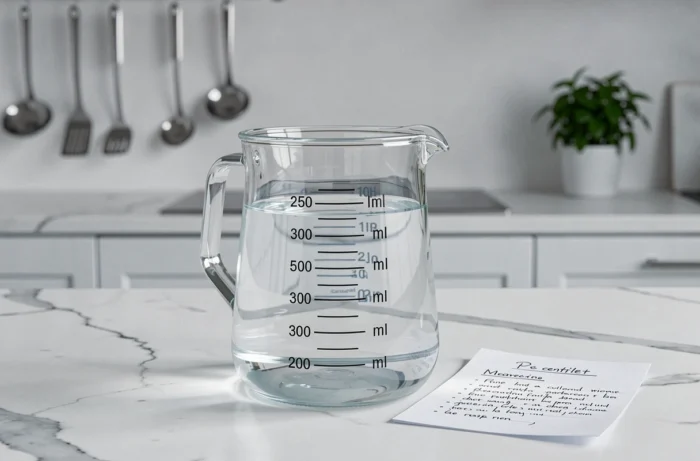
Measuring 25 cl without a measuring jug: everyday containers
Don’t have a measuring jug handy? Several everyday items can give you a reliable estimate of 25 cl.
- A standard coffee cup holds about 10 cl. Two and a half cups will therefore give you 25 cl, although this is only an approximation, as cup sizes and shapes vary.
- A classic mustard glass holds about 20 cl. You’ll need another 5 cl, or roughly one heaped tablespoon (a tablespoon holds about 1.5 cl).
- A soup plate filled to the brim holds about 25 cl of liquid, making it a handy guide for this exact amount.
These equivalents are useful in a pinch, but they’re still estimates. For baking recipes, a graduated measuring jug is the only reliable tool. In savoury cooking, a margin of a few centilitres often goes unnoticed.
Reading a measuring jug: the technique that improves accuracy
Getting the calculation right isn’t enough if you misread the volume. Have you ever noticed that the water level in a container looks slightly curved? This is called the meniscus. With a clear liquid such as water or milk, the surface forms a slight dip in the centre.
Place the container on a flat surface and read the level at eye height to eliminate the main source of error. Align your eye with the bottom of the meniscus, not with the liquid that rises along the sides of the container.
Another potential pitfall is the scale itself. On a large one-litre measuring jug, the markings are often 50 ml apart (or 5 cl). To measure 25 cl, you’ll need to aim for the midpoint between two markings, which means estimating by eye. A smaller jug, marked every 10 or 25 ml, lets you read the amount directly.
Tip for small amounts
For amounts under 10 cl, tablespoons are more practical than a large container. A level tablespoon holds about 1.5 cl. Counting spoonfuls gives you a more consistent measure than using a jug with markings that are too far apart.

Volume and weight: the mix-up that throws off recipes
Converting 1/4 litre to centilitres is straightforward. But a common mistake is to treat 25 cl as 250 grams, regardless of the ingredient. This equivalence only works for water.
25 cl is a volume, not a universal weight. Every ingredient has its own density. Whole milk is slightly heavier than water. Oil, by contrast, is lighter: 25 cl of oil weighs less than 25 cl of water.
The difference is even greater with flour. Filling a 25 cl measuring jug with flour does not give you 250 grams, because flour is much less dense than water. When a recipe gives a weight in grams, use a scale. When it gives a volume in centilitres, a measuring jug is enough.
Common fraction conversions at a glance
| Fraction of a litre | Centilitres | Millilitres |
|---|---|---|
| 1/5 litre | 20 cl | 200 ml |
| 1/4 litre | 25 cl | 250 ml |
| 1/3 litre | 33 cl | 330 ml |
| 1/2 litre | 50 cl | 500 ml |
| 3/4 litre | 75 cl | 750 ml |
This table covers most of the fractions you’ll come across in French-language cookbooks. The calculation is always the same: multiply the fraction by 100 to get the number of centilitres.
Once you get into the habit, there’s no need to look up the answer for every recipe. The principle of a hundredth of a litre turns any fraction into a value you can read on your measuring jug, so you can get the measurement right first time.