The Pays d’Apt Luberon Community of Communes (CCPAL) organizes its interventions around mandatory and optional competencies that far exceed the classic administrative perimeter. With nearly 200 agents spread across 14 services, this intercommunal entity in Vaucluse manages highly technical projects in a territory marked by specific hydraulic, energy, and tourism challenges unique to the Luberon.
Collective Self-Consumption and Energy Transition in Pays d’Apt
A large-scale collective self-consumption operation on the built heritage of the CCPAL is on the agenda for the community council meeting on October 15, 2026. The system, governed by the Energy Code, allows several public buildings to share locally produced electricity, for example through photovoltaic installations, without relying on the traditional supply network.
The setup requires a limited geographical perimeter around the injection point, an agreement with the distribution network manager, and an organizing legal entity. For an intercommunal entity, the challenge lies in coordinating production sites and consumption sites scattered across multiple municipalities.
This initiative accompanies the revision of the CCPAL Climate Plan, currently open for public consultation. Residents can contribute directly, a participatory aspect that is uncommon for intercommunalities of this size. The resulting guidelines will determine energy investments for the coming years.
Documents related to these deliberations and the community’s competencies can be consulted on cc-paysapt.fr, the community of communes’ website.
Water Management and Flood Risk in the Calavon-Coulon Basin
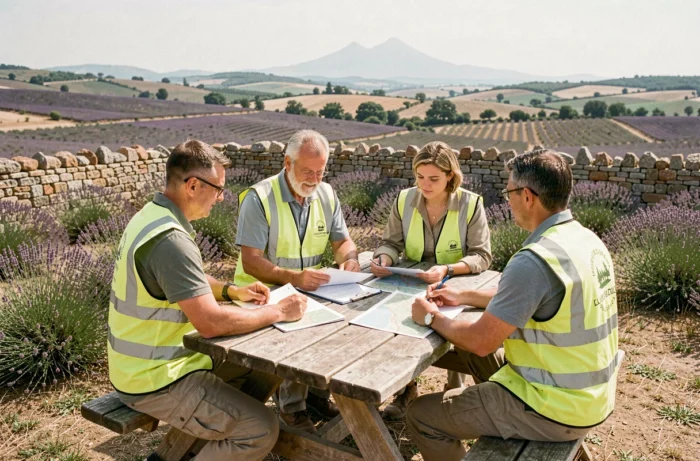
The Drinking Water, Collective Sanitation, and SPANC service remains one of the most sought-after technical poles of the CCPAL. Water resource management is organized through a partnership with the Luberon Regional Natural Park.
The community office has studied financial participation in the Territorial Project for Water Management led by the PNR. The stakes go beyond providing drinking water: preserving aquatic environments, securing withdrawals, and adapting to increasingly marked drought episodes in Provence.
Flood Crisis Management Exercise
The Vaucluse prefecture conducted a civil security exercise targeting flood risk in the Calavon-Coulon basin. Several municipalities of the CCPAL were directly involved:
- Apt, Gargas, and Goult, in the valley bottom, exposed to rapid floods from the Calavon
- Saignon and Saint-Martin-de-Castillon, affected by runoff on the slopes of the Luberon
- Saint-Saturnin-lès-Apt, vulnerable to Cevennes episodes due to its geographical position
The exercise tests the municipal safeguarding plans, coordination between municipal and intercommunal levels, and the CCPAL’s ability to mobilize its logistical resources in a crisis situation. The feedback from the experience then informs the updating of regulatory documents.
France Services Bus and Mobile Access to Administrative Procedures
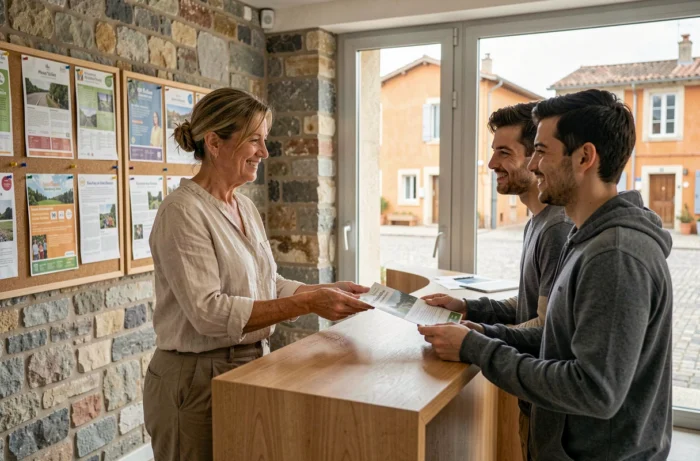
The ANCT lists a France Services Bus Pays d’Apt Luberon among the public service access initiatives in Vaucluse. The mobile format addresses a reality of the territory: rural municipalities scattered throughout the Luberon, where the journey to Apt for administrative procedures poses a concrete obstacle for less mobile populations.
The bus stops in communities far from the town center and offers assistance with online procedures (CAF, taxes, health insurance, prefecture). This service complements the fixed France Services Houses. It reflects the digital inclusion policy that the CCPAL promotes at the intercommunal level.
Internal Organization and Technical Services of the CCPAL
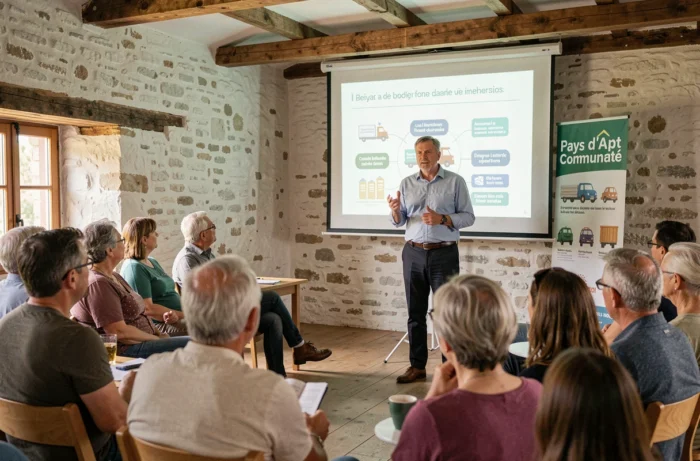
The general management of services oversees 14 poles that cover all transferred competencies. Aside from support functions (general administration, public procurement, legal affairs), the CCPAL relies on well-identified operational services:
- Economic development, coordinated with local employment and training stakeholders
- Tourism and Grand Site Operation, a strategic lever for a territory classified within the PNR of Luberon
- Music and Culture Conservatory, an optional competency that distinguishes the CCPAL from many rural intercommunalities
- Early childhood, with direct management of childcare facilities
The urban planning service processes land use authorizations on behalf of member municipalities. This pooling ensures a homogeneous processing of building permits across the entire intercommunal area. In PNR zones, landscape and environmental constraints weigh on each project, making this competency crucial for the coherence of urban development.
The collection and treatment of waste, funded by the TEOM, raise sorting and recovery issues specific to tourist areas. The population of the living area fluctuates significantly with the seasons, complicating service sizing.
Recent deliberations of the CCPAL outline an intercommunality that goes beyond its basic missions. Tourist pressure, water resource management, energy self-consumption: the ongoing projects will shape the territory for years to come.