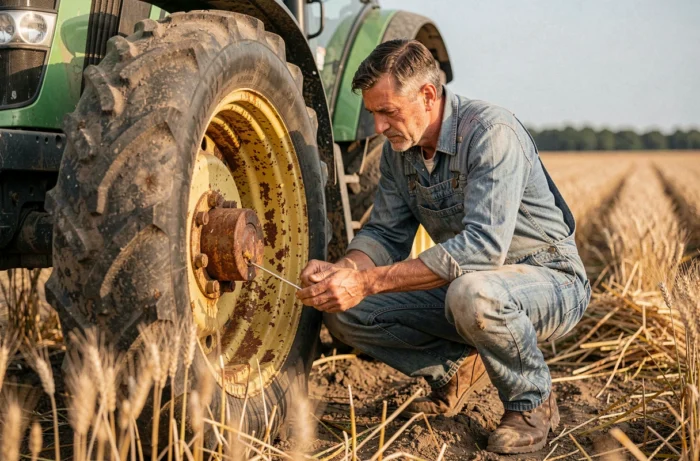
Mechanization represents one of the heaviest cost items in a farming operation, with significant variations depending on production systems. Choosing agricultural equipment is not just about comparing technical specifications: the total cost of use, regulatory compatibility between equipment, and the acquisition model (ownership, Cuma, ETA) determine the actual profitability of each investment.
Tractor-tool compatibility: the regulatory braking trap
One point that most buying guides overlook concerns the regulation of braking for trailers and towed tools. Since recent regulatory changes, a new tool equipped with a dual hydraulic braking system cannot be hitched to a tractor that only has a single line.
Before any purchase, it is essential to check the compatibility of the tractor-tool pair based on this specific criterion. An older tractor may perfectly meet your power needs but become unusable with a new spreader or a recent dump truck if the braking circuit does not match.
This constraint particularly weighs on farms that are gradually renewing their fleet. Each piece of equipment available on Loisiragri deserves to be compared with the characteristics of the tractor in service before ordering, not after delivery.
The circulation of agricultural machinery on public roads is also regularly reminded by state services: signage, dimensions, speed. Non-compliance with braking regulations exposes one to a warranty refusal in case of a claim, beyond the fine.
Cost per hectare: going beyond the catalog price
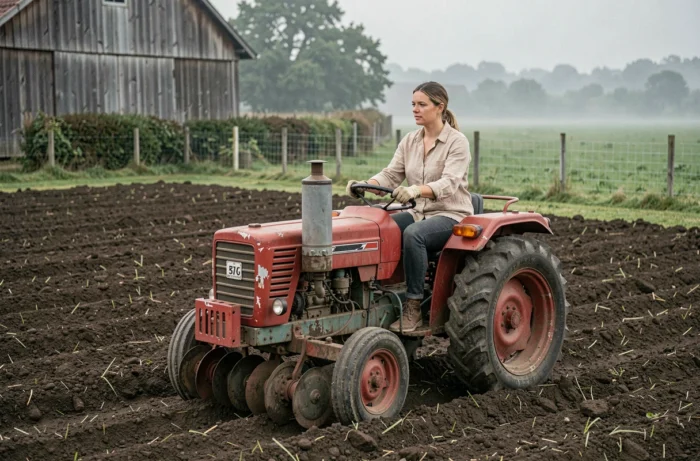
The purchase price represents only a fraction of the actual cost of agricultural equipment. The cost price guides published by Cuma federations rely on actual farm accounts to calculate the cost of use per hour or per hectare. They include depreciation, maintenance, fuel, insurance, and repairs.
A manure spreader, for example, may display a reasonable catalog price but generate a high cost per hectare if the annual spread volume remains low. Conversely, more expensive equipment, used over a large area or shared among several operators, sees its unit cost drop rapidly.
Often underestimated costs
- The insurance for precision equipment (GPS, auto-steering, sensors) represents a distinct additional cost from the standard tractor insurance, and coverage conditions vary significantly from one contract to another.
- Preventive maintenance of the tractor (filters, belts, levels, lubrication) conditions the longevity of the entire traction chain. A lack of maintenance on the tractor mechanically impacts the hitched tool.
- Transporting equipment between scattered plots adds time, fuel, and wear, especially for fragmented farms.
We recommend systematically calculating the total cost before any investment decision, using Cuma scales as a reference rather than manufacturer estimates.
Ownership, Cuma, or ETA: deciding based on real needs
Owning equipment is not always the most rational solution. The current economic context pushes many farmers to approach equipment purchases with more caution, distinguishing urgent needs from equipment that can be shared or renewed later.
Comparing the cost of an external service (ETA) or Cuma equipment with outright purchase requires integrating several elements that quotes do not always mention, assuming equivalent service.
- The fuel consumed during the service: included in the ETA rate, at your expense in Cuma or for owned equipment.
- The operator: an ETA provides the operator, freeing up work time on the farm. In Cuma, the shared schedule can create calendar tensions during peak periods.
- The cash flow effort: an outright purchase mobilizes capital immediately, while Cuma spreads the investment. Using ETA transforms a fixed cost into a variable cost.
- Availability: owning your equipment guarantees immediate access, a decisive advantage for interventions conditioned by weather (harvest, treatments).
For tools used a few days a year (subsoiler, grass roller, specialized seeder), sharing through a Cuma or delegating to an ETA is almost always justified. In contrast, equipment used more than thirty days per campaign is better owned to secure responsiveness.
Agricultural robots and precision equipment: operational limits
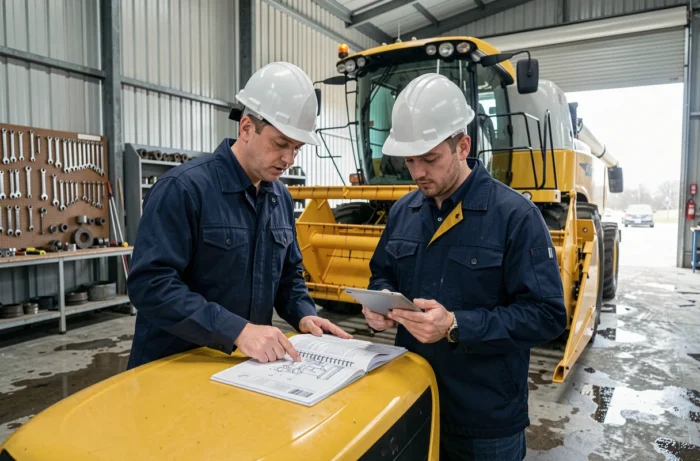
Mechanical weeding robots or RTK auto-steering systems are generating increasing interest. Documented feedback on deployments in large crops shows a real gain in labor intensity and precision of intervention. However, their adoption does not eliminate all organizational constraints.
A weeding robot, for example, requires a rigorous preparation of the plots (absence of obstacles, regular inter-rows) and supervision that mobilizes human time, even if the physical task disappears. Precision equipment mounted on tractors (section control, dose modulation) requires initial training and specific maintenance of the sensors.
The insurance for these connected devices remains a point of vigilance. Standard agricultural equipment contracts do not always cover embedded electronic components, GPS antennas, or control units. Checking the clauses before equipping avoids discovering an exclusion after a claim.
The choice of agricultural equipment commits the operation for several campaigns. Checking regulatory compatibility, calculating the total cost per hectare, and comparing acquisition methods before signing an order protects cash flow better than a year-end discount.