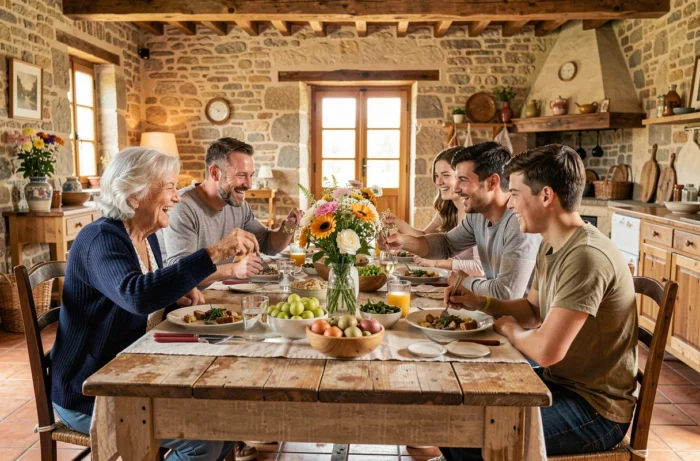
In France, family structure has profoundly transformed over a few decades. Recent data from Insee shows that single-parent families have seen their share increase in almost all departments between 2017 and 2023, with particularly high levels in overseas territories. At the same time, alternating residence concerns 14% of children of separated parents in 2023. These figures depict a family landscape that is much more diverse than the single model long presented as the norm.
Single-parent families and poverty: a link that averages obscure
The family configuration directly conditions exposure to economic difficulties. An analysis by Insee covering trajectories between 2021 and 2024 establishes that people in single-parent families are more exposed to persistent poverty than those living in couples with children.
This observation is not limited to a gap in income. It reflects a cumulative set of constraints: limited access to certain childcare options, work schedules that are difficult to reconcile with parental life, and mental load concentrated on a single adult. Territorial disparities exacerbate the situation, with overseas departments concentrating both a higher proportion of single-parent families and higher poverty rates.
For those who wish to learn more about family on Pour Qui Pourquoi?, these economic realities provide a more meaningful starting point than theoretical definitions.
Public policies struggle to capture the complexity of these trajectories. Assistance is often calibrated to fixed situations (isolated parent or couple), while family paths oscillate between several configurations over the years.

Family roles: the growing place of caregivers
Talking about roles within the family goes beyond the parent-child duo. A dimension still little visible in public debate concerns family members who take on a caregiver role for a dependent relative or someone with a disability.
According to a summary relayed by Drees, many caregivers combine this responsibility with a job or studies. Some take it on without any external support, leading to exhaustion documented by several institutional surveys.
Siblings and disability: a blind spot
Unapei has highlighted the specific situation of siblings of a disabled person. These siblings bear an emotional and logistical burden rarely recognized by support systems. Their role often begins in childhood and extends into adulthood, sometimes for several decades.
- The family caregiver has not always chosen this role: it often results from a lack of institutional alternatives or a sense of filial obligation
- The consequences on the caregiver’s mental health (anxiety, social isolation) are regularly reported by specialized associations
- Legal recognition of the caregiver status is progressing, but remains out of sync with the scale of the phenomenon
Alternating residence and co-parenting after separation
Parental separation does not automatically mean an equal sharing of daily life with the child. The figure of 14% of children in alternating residence in 2023, according to Insee, strongly nuances this idea. The majority of children of separated parents primarily reside with one parent, most often the mother.
Several factors explain this imbalance. Geographic distance between parental homes complicates school logistics. Income disparities between the two households also play a role: maintaining two living spaces suitable for the child requires resources that not all households have.
What co-parenting concretely requires
Beyond the legal framework, co-parenting relies on a capacity to communicate that is not self-evident after a breakup. Material constraints (housing, distance, income) are compounded by relational difficulties that complicate the establishment of a stable functioning for the child.
The question remains open for situations where one parent lives in a rural area far from services (school, health, activities). Data is still lacking on the long-term impact of alternating residence according to geographic setting, an angle that Insee’s longitudinal surveys could shed light on in the coming years.

Family socialization: what has changed in transmission
The family remains the primary instance of socialization. It is within this framework that the child integrates social codes, behavioral norms, and values that will structure their future interactions.
What has changed is the diversity of models to which the child is exposed. Socialization no longer occurs through a single family model but through the coexistence of varied configurations in the immediate environment: blended families, single-parent families, same-sex parent families, multigenerational families.
- Education about screens and digital technology has become a daily negotiation ground between parents and children, without a stabilized normative framework
- The transmission of cultural heritage (language, religion, culinary practices) faces challenges from the geographical mobility of families
- The role of grandparents in socialization varies significantly depending on geographic proximity and their health
The educational function of the family no longer operates in isolation. School, social networks, and peers intervene increasingly early in the child’s identity construction. Parents retain a structuring role, but they share it with influences they can only partially control.
The changes in family in France are not merely a narrative of decline or progress. They reflect continuous adjustments in response to economic, territorial, and relational constraints. Understanding these family dynamics requires looking at the data rather than representations, and accepting that the diversity of paths is now the rule.